When a faucet sprayer stops working, the problem is not always the faucet itself. A kitchen tap can deliver a perfectly normal stream through its spout while the side sprayer barely dribbles, refuses to switch on, or sprays in every direction. The useful clue is where the water still flows.
Start by identifying what is not working
Turn on the kitchen faucet and compare the main spout with the sprayer. If the spout has strong flow but the sprayer does not, concentrate on the sprayer assembly. If both are weak, look further upstream at the faucet’s supply and internal components.
Side sprayer or pull-down sprayer?
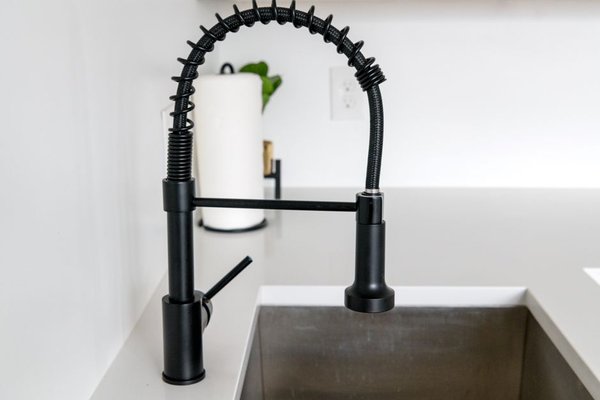
A separate side sprayer usually has a trigger and a diverter that redirects water away from the main spout. A pull-down faucet has a spray wand built into the spout, often with a button to change spray patterns. That button is not necessarily the same kind of diverter found in a side-spray faucet.
Check the easy causes before taking anything apart
Start with the simple things: make sure the faucet is fully open, inspect the hose beneath the sink for sharp bends, and confirm the sprayer trigger moves freely. Pull-down hoses can catch on stored cleaning bottles or plumbing fittings. A hose that folds when extended may cause faucet sprayer low pressure only in certain positions.
Run the sprayer while gently changing the hose position. If the stream improves when you straighten a bend, you have found an important clue. Clear the obstruction and check whether the hose has a lasting crease.
Clean the spray head and its inlet screen
Mineral deposits and sediment commonly narrow tiny spray openings. A head that produces uneven jets or a mist in unexpected directions may simply need cleaning. First, try wiping the nozzles with a soft cloth or gently rubbing flexible rubber tips, if fitted. Avoid sharp metal picks that could damage the openings.
For a removable head, shut off the faucet, cover the sink drain, and follow the manufacturer’s instructions for detaching it. Some models have a small screen washer where the wand joins the hose. Carefully remove and rinse that screen, keeping track of its orientation and any separate sealing ring.
If the manufacturer permits it, soak an appropriate removable component in diluted white vinegar to loosen scale. Rinse thoroughly afterward. Do not leave decorative finishes, seals, or components in vinegar without checking care guidance; some materials can be damaged. Reassemble the head, turn on the water, and inspect the connection for leaks.
Use the hose-only test to locate the blockage
On many pull-down and pull-out faucets, a useful kitchen faucet sprayer repair test is to compare flow with the wand attached and removed. Secure the hose so it cannot retract into the faucet body, then unscrew the wand according to its instructions. Keep the open hose pointed into the sink, start with a low flow, and briefly run water.
If water flows strongly from the bare hose but weakly through the reattached wand, the screen or wand is probably restricting it. If the hose itself produces only a trickle, inspect for kinks, blocked connectors, or an upstream fault.
For example, imagine the sprayer loses pressure whenever you pull it toward a large pot. Under the sink, the hose loops around a detergent bottle. Moving the bottle restores flow instantly. That is a sprayer hose problem, not a reason to replace a faucet cartridge.
What if the side sprayer will not divert water?
A sink sprayer diverter directs flow from the regular spout to a separate side sprayer when its trigger is pressed. If water continues to pour from the spout while the side sprayer runs weakly, the diverter could be sticking, clogged with debris, or worn. A damaged trigger can produce similar symptoms, so examine the spray handle first.
Diverter locations and removal methods differ substantially by brand and model. Some sit inside the faucet body; others are integrated into a hose connection. Find the faucet’s model number and parts diagram before opening it. Turn off both under-sink shutoff valves, relieve remaining pressure, and cover the drain before removing any component.
Clean an accessible diverter only as directed by its manufacturer. Replace a cracked, worn, or persistently stuck part with the correct model-specific replacement. Avoid guessing at universal parts or forcing a retaining clip.
When both the faucet and sprayer have weak flow
If neither outlet produces a normal stream, cleaning only the sprayer probably will not solve the problem. Confirm the under-sink shutoff valves are fully open and check whether other fixtures in the home have lost pressure. A clogged spout aerator, restricted supply line, or faucet cartridge can also limit flow, depending on the design.
Test hot and cold separately and note whether the change happened suddenly after plumbing work. Debris released during repairs can collect in screens or faucet passages. For broader diagnosis, a guide to kitchen faucet low water pressure is a useful next step. If the spout also drips while turned off, fixing a leaking kitchen faucet is a separate repair.
Choose replacement parts carefully
Spray heads, hoses, quick-connect fittings, and diverters are not interchangeable across every faucet. Check the maker, model, connection style, and installation diagram. Replacing only a failed wand or hose is often more practical than replacing the complete tap, provided the rest of the assembly is sound.
After any kitchen faucet sprayer repair, run water through both modes, extend and retract the hose, and look beneath the sink for drips. If the faucet cartridge also needs attention, consult a model-specific guide to replacing a kitchen faucet cartridge.
Frequently asked questions
Why is my faucet sprayer not working when the spout works?
The problem is often local to the sprayer: a clogged screen, blocked spray head, kinked hose, stuck trigger, or side-spray diverter fault. Compare flow through the hose and head where the design allows.
Can I fix a sprayer that has very low pressure?
Often, yes. Start by straightening the hose and cleaning the nozzles and inlet screen. If the bare hose has strong flow but the assembled head does not, the head may need replacement.
Why does water still come from the faucet when I press the side sprayer?
A little residual water may drain briefly, but substantial ongoing flow from both outlets can indicate that the diverter is not switching correctly. Check the side-spray trigger and consult the faucet’s service instructions.
Should I replace the entire faucet if the sprayer breaks?
Usually not immediately. Many models accept a replacement spray wand, hose, or diverter. Complete replacement makes more sense when the faucet body is damaged, suitable parts are unavailable, or several components are failing.
Get the sprayer working again
Start with the symptom, not the toolbox. Strong flow at the spout points toward a local sprayer issue; weak flow everywhere calls for a broader check. Cleaning a screen, freeing a kinked hose, or replacing a model-specific diverter can restore useful spray performance without turning a small kitchen inconvenience into a major repair.